
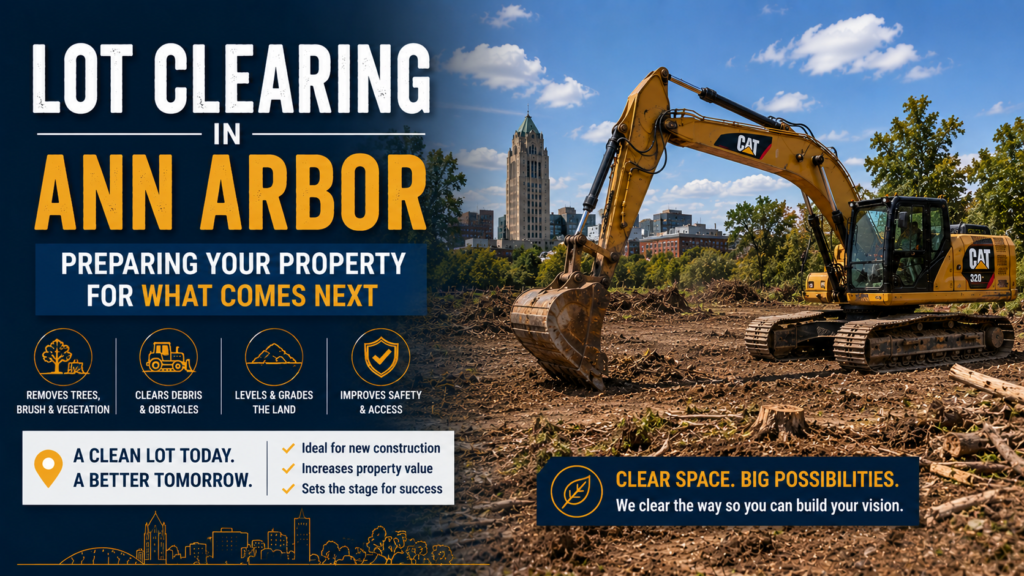
A lot is the starting point of almost every construction or development project. Whether it is a wooded residential parcel in one of Washtenaw County’s rural townships, an overgrown infill lot in an established Ann Arbor neighborhood, or a commercial development site on the city’s urban fringe, the lot must be cleared before anything else can happen. Lot Clearing Ann Arbor is the process of removing vegetation, debris, old structures, and any other obstacles from a parcel of land to prepare it for its next intended use.
In Ann Arbor and the surrounding communities of Washtenaw County, lot clearing is a frequently requested service for a wide variety of property owners and project types. Understanding what lot clearing involves the types of work it encompasses, the equipment used, the regulatory requirements that apply in Michigan, and how Ann Arbor’s specific landscape conditions affect the process helps property owners approach these projects confidently and realistically.
What Is Lot Clearing?
Lot clearing refers broadly to the comprehensive removal of all material from a parcel of land that would prevent or complicate the site’s intended use. This includes trees of all sizes, brush and shrubs, invasive vegetation, stumps and surface roots, rocks and boulders, old fencing or outbuildings, pavement remnants, concrete pads, accumulated debris, and any other material that occupies the space the property owner needs to use.
Lot clearing may be performed as the first step in a construction project clearing the way for site grading, utility installation, and foundation work. It may be performed to reclaim an overgrown property for recreational use, agricultural use, or simply improved aesthetics. It may be performed on a vacant investment property to make it more marketable by allowing buyers to see and evaluate the land without the visual barrier of dense vegetation. And it may be performed as part of an ongoing maintenance program for large properties where vegetation must be periodically controlled.
The scope of lot clearing varies enormously from project to project. A small residential lot covered in overgrown brush and a few small trees can be cleared in a single day with compact equipment. A large, heavily wooded commercial development parcel may require weeks of work with multiple pieces of heavy equipment to clear completely. The most important first step in any lot clearing project is an accurate assessment of what is on the lot and what will be required to remove it.
Common Lot Clearing Scenarios in Ann Arbor
Infill Lot Clearing is among the most common lot clearing scenarios in Ann Arbor’s established neighborhoods. The city’s competitive real estate market has created demand for development on vacant or underutilized lots in desirable near-campus and near-downtown locations. Many of these lots have been vacant for years and have become overgrown with opportunistic vegetation, invasive species, and accumulated debris. Clearing them typically involves removing this growth with compact equipment, managing the debris, and delivering a clean parcel ready for the development process.
Rural and Township Lot Clearing is common in Washtenaw County’s townships Ann Arbor Township, Webster Township, Dexter Township, Lima Township, and others where larger lots are the norm and a significant percentage of them are forested. Buyers of rural properties frequently need to clear areas for house sites, driveways, septic systems, and agricultural or recreational uses. This type of clearing often involves removing mature trees, managing large volumes of wood, and working on terrain that may be uneven or have limited equipment access.
Lot Clearing in Conjunction with Demolition is frequently required when a structure is being demolished and the lot is being prepared for new construction. After the demolition crew removes the building, the lot clearing crew may need to address mature vegetation in the yard, remove old fencing, clear overgrown areas, and otherwise prepare the full parcel for new development not just the area where the structure stood.
Lot Clearing for Land Improvement involves clearing without immediate construction plans improving the visual and functional condition of a property for personal use, sale preparation, or simply because the overgrowth has become a problem. This might mean removing invasive species that are spreading from a vacant lot to neighboring properties, clearing brush to eliminate snake and rodent habitat, or opening a wooded parcel to allow more light and usable space.
Lot Clearing Methods and Equipment
The method and equipment used for lot clearing in Ann Arbor depend on the specific conditions of the lot. A few primary approaches are commonly used, often in combination.
Mechanical Clearing with Bulldozers and Excavators is the most effective approach for lots with significant tree cover, large stumps, or substantial debris that must be removed. Bulldozers can efficiently push over trees and pile material for processing or loading. Excavators provide greater precision and can dig out stumps and root masses. This approach is the right choice for lots being prepared for construction, where complete stump and root removal is required.
Skid Steer and Compact Track Loader Clearing is used for smaller lots, lots with limited equipment access, or lots where a smaller machine footprint is needed to protect surrounding improvements. These machines can work in tight spaces while still handling trees of moderate size, brush, and debris effectively. In Ann Arbor’s established neighborhoods, where lots are often surrounded by existing structures and landscaping, compact equipment frequently makes the difference between a clean result and significant collateral damage.
Forestry Mulching converts trees, brush, and vegetation into wood chips in a single pass, eliminating the need to haul large volumes of bulky material off-site. This method is fast, cost-effective, and environmentally beneficial the mulch layer it leaves behind reduces erosion, retains moisture, and decomposes naturally. In Ann Arbor, forestry mulching is frequently used for lot clearing projects where the ground will not immediately be built upon, as it provides a clean, neat result without the expense of hauling debris away. It is not suitable for lots where slab foundations will be poured directly on the cleared ground, as stumps must be fully extracted in those applications.
Manual Clearing with hand tools is appropriate for small areas, selective clearing around existing trees or landscaping that must be preserved, or tight spaces where machinery cannot operate safely. It is labor-intensive and slower than mechanical methods, but it allows for precise control over exactly what is removed and what is left in place.
Michigan’s Regulatory Framework for Lot Clearing
Lot clearing in Michigan is subject to several regulatory requirements that property owners should understand before work begins. Under Part 91 of Michigan’s Natural Resources and Environmental Protection Act, any land clearing that disturbs more than one acre of ground, or that occurs within 500 feet of a lake or stream, requires a Soil Erosion and Sedimentation Control (SESC) permit from the relevant county drain commissioner or road commission. In Washtenaw County, the SESC permit is obtained through the Washtenaw County Water Resources Commissioner’s office. The permit requires submittal of an erosion control plan describing how the cleared site will be managed to prevent sediment from running off into drainage systems and waterways.
For lot clearing projects in Ann Arbor’s city limits, additional requirements may apply regarding tree removal. Ann Arbor has specific regulations governing the removal of trees in certain contexts, and property owners should verify applicable requirements with the City’s Planning and Development Department before clearing trees on their property.
Clearing on lots that contain or are adjacent to regulated wetlands requires authorization under Michigan’s Part 303 Wetlands Protection Act and potentially under the federal Clean Water Act. Given that Washtenaw County contains significant wetland areas many associated with the Huron River and its tributaries lot clearing projects should include an assessment of whether any wetland features are present before work begins.
Post-Clearing Site Considerations
Once a lot has been cleared, several additional steps are typically required before the site is ready for its intended use. Debris disposal or management must be addressed: cleared material that has not been mulched on-site must be loaded and transported to an appropriate facility. In Michigan, burning of cleared vegetation is subject to local burning ordinances and may require a permit.
Erosion control measures must be installed promptly after clearing is complete. Exposed soil particularly Ann Arbor’s clay-based soils is highly susceptible to erosion from rainfall. Silt fences along downslope boundaries, erosion control blankets on slopes, and temporary seeding of exposed areas are standard erosion control practices that protect both the cleared site and downstream drainage systems.
Grading typically follows lot clearing, shaping the cleared ground to the slopes and elevations required for drainage, construction, or the property owner’s intended use. In Ann Arbor’s clay soils, where natural drainage can be slow and complex, grading that establishes positive drainage away from building areas and toward designed drainage outlets is essential to the long-term usability of the cleared lot.
Final Thoughts
Lot clearing in Ann Arbor is the starting point of countless residential and commercial development projects across Washtenaw County, and it is equally valuable for property owners looking to reclaim, improve, or simply better manage their land. Understanding what lot clearing involves the methods and equipment used, the regulatory requirements under Michigan law, the specific challenges posed by Ann Arbor’s clay soils and Huron River watershed context, and what needs to happen after the clearing is done allows property owners and developers to plan their projects realistically and achieve the clean, usable, well-prepared lots that every successful development begins with.